In an intriguing article/newsletter/blog post, “REPORT OFFERS RARE DATA ON SOLITARY CONFINEMENT IN UNITED STATES” real data is offered on solitary confinement in the American prison system. The numbers are impressive. This article took its information from a report, “Aiming To Reduce Time-In-Cell.” published by “The Association of State Correctional Administrators, of The Arthur Liman Public Interest Program, Yale Law School in November 2016.
The report noted that “In the fall of 2015, 67,442 people were locked in a cell for at least 22 hours a day, for 15 continuous days or more.” The data was collected from 45 of the 50 state prison systems, and, 48 of the 53 federal prison jurisdictions.
Texas, one of my ancestral home states, that has the highest number of death row inmates in a county jail in the country, Harris County of Houston, was second only to California in the total number of inmates in solitary.
As far as the mentally ill population is concerned, the article states, “Just over 54,000 incarcerated men are reported to have serious mental health issues in general population. A little more than 5,000 incarcerated men with serious mental health issues are in isolation.”
As a final note, the percentages of inmates in solitary confinement is quite striking in some states that have relatively small comparable total state populations.
In an unassuming online article published by WDKI television of Kansas, “Mental health reform proposed in Kansas,”there is laid out a summary of the initiative(s) now stirring in Kansas that show the simplest and some of the most needed mental health reform measures needed in this country. The irony is that they are incredibly simple, intuitive and long known as needed by policy wonks in the field and providers of all types in the mental health professions.
They boil down to basically simply and (stupidly enough) restoring some of the most basic lynch pins of our system of mental health care delivery.
Those essential foundations or struts of the superstructures of local or regional mental health care delivery systems of ANY size, consists of two basic things, money (“funding” in the ever dominant bureaucratic talk) and providers. Such a non-complex concept that we are starting to circle around to and rediscover. [Read angry irony in that last sentence please].
The last 20 years have seen state legislatures cut funding for state and local mental health services, fight Medicaid expansion to help provide mental health insurance and thereafter access to the ‘new’ privatized’ models of MH services agencies {they used to be called “mental health centers” in each country]. In most states, the new mental health reforms were SUPPOSED to cover the uninsured but somehow they often did not because of limited funding {read “block funding”]. Block funding as a concept originated mostly under the Nixon administration and since then has been largely used by a political party of a certain flavor tp punish frowned upon governmental services, such as Planned Parenthood, National Public Radio, and other entities, you get the idea. The concept was that funding was not cut off to avoid too much blowback, but given in limited and sometimes ever shrinking amounts with the admonition to choose upon what to spend it, leaving the do-gooders in the agencies to make the cuts and make the less than kind decisions and “be the bad guys.” That way legislators could crow to their constituents that they had not increased spending and had not cut funding [the latter often untrue but who’s quibbling here, this is politics…).
The other major pillar of deconstruction of the old county-based mental health system has been the ever shrinking pool of psychiatrists, counsellors, substance abuse counsellors, psychologists, child therapists of all disciplines and especially outreach workers in the old public health system sense, the “outriders,” who visited homes and if nothing else dropped the essential daily antipsychotic doses into patients’ mouths and made sure they swallowed them. It’s called “compliance.” Training programs until the last 10 years have done nothing but stay static in numbers of graduates or shrink dramatically as my one training program did for years. Some few departments of psychiatry closed or merged such as the famous occurrence at Tufts University Dept. of Psychiatry in Boston decades ago which was essentially saved and bought out by Harvard.
Reading the article makes me realize it has taken 30 years to pummel into the heads of the so-called reformers that three simple needed measures: outpatient services including residential systems of living centers for displaced mentally ill out of destroyed or as they would say in the Peron dictatorship years in Argentina, “disappeared,” hospital beds, and increase the funding and programs for providers, in this case, psychiatric residents. Sen. Chris Murphy’s bill and Former Rep. Patrick Kennedy’s now in effect merged national mental health reform bill does the same things largely except on a national basis
Dr Harold Carmel MD of Duke Psychiatry said now over a decade ago, “it will take us 10 years to get back to where we were 10 years ago.” At least we have real starts now.
An article by Annie Gilbertson KPCC news of Califorma that appeared yesterday, “California counties look to private firm to run new state psychiatric hospital, again takes a look at a solution that has been lingering in the wings of state legislatures and policy wonks for several years now, and that is of getting out of the business of running and financing state psychiatric hospitals altogether by the good old mechanism of “outsourcing.” Outsourcing has a decidedly mixed track record, with some successes in various industries, massive job losses in others. In some industries such as major passenger airlines big and small, outsourcing has had disastrous results. Some readers may be able recall vital passenger airplane maintenance duties being outsourced to private companies to avoid higher union wage costs. The outsourcing companies would save the airlines money by employing lower-paid and as it turned out less well-trained technicians and cut corners such as quality control, with mixed and sometimes catastrophic results. Even the ‘business’ of war in the George Bush years saw the use out “outsourcing” which is some military experts’ opinions and views were nothing more than employing American mercenaries to fight in questionable military operations in Iraq and Afghanistan. Remember the ill-fated romance with the firm Blackwater that turned out to be a mess?
The federal and state correctional systems have been utilizing corrections companies to run prisons for over two decades now. There are some very solid parallels between the prison “industry” and the state psychiatric hospital spheres. Both of these areas of operation of governmental entities have in the last several decades the huge costs of replacing dozens and dozens of aging, falling down, buildings and facilities built in the late 1800’s. I recall consulting at a state prison in my home state for several years. that prison was from the late 1800’s. Parchman prison in Louisiana is another very famous example of a prison from a different, not so ‘nice’ era.
Ms. Megan Hart of the Kansas Public Radio Station KCUR and the group Heartland Health Monitor partner KHI News Service hasbeen following and chronicling the long sad story of the Osawatomie State Hospital in Kansas for quite some time now, nearly two years or perhaps longer, that this writer has been aware. Ms. Hart’s latest article, “Osawatomie State Hospital: A Leading Light for Mental Health Care Slowly Dims.” published July 25, 2016 documents very ably both the issues of this state hospital, its parent state, and the social vise that all too many such state hospitals more or less find themselves facing in this time of hoped for reform.This piece of American state hospital history is in many ways not unique to the fascinating and very checkered social history of the American state psychiatric hospital for public inpatient care of the seriously and chronically mentally ill.
I have long awaited this juncture, the partial passage of the most significant, and hopefully helpful federal mental health reform legislation in this country since President Kennedy’s 1963 Community Mental Health Center Act, the Helping Families in Mental Health Crisis Act,” or HR 2646. [I would encourage readers to actually follow the link to the text of the bill and give it a studied read]. Politics is ordinarily as an area I steer away from in my public blog writings as for the last 30 years it has been nothing more than a hopeless, dirty, pointless and non-productive quagmire that until recently has held no real relationship to the issues dear to this effort’s mental health professional’s heart.
But the time has come to start commenting upon, openly following in [I hope] responsible medical journalistic fashion, the life, future and fruits and/or unintended consequences of the slow legislative efforts and developments of years of failed political/legislative efforts to repair our long broken mental health care delivery system, both public and private. The Helping Families Crisis Act now appears to be the first piece of legislation with at least a reasonable potential to effect a vast amount of good effort in the right directions and quarters. One of the many recent news articles, printed over the last year or so to keep this bill alive in the public’s mind, prompted my entering into the national discussion regarding this legislation and its significance. I had held off doing so as for months it has appeared that it would be lost in the polarization of the political parties of the last four Presidential terms or buried/ignored because of lack of support since it concerned “mental health issues,” and all their complexities that at time legislators seems to avoid like the plague. But now it has recently “made it over the top,” as it were and appears destined for passage by the Senate in the near fall. In fact, it has seemed to gain a sort of hallowed status as one of those bills that the pols finally realize they had better jump on to the bandwagon rather than ignore any longer. And politically speaking, it has greatly helped that two brave Republican Congressman have fought hard for this legislation and made it politically acceptable to even most extremists to support.”
A now slightly dated article published July 4, 2016 in many papers authored by Lateshia Beachum of the Washington Post that I came across in the Walla Walla Union Bulletin of Washington state recorded the magnitude of the cut backs nationally in public state hospital beds psychiatric beds. While this has long been known as a trend occurring over at least the last five decades, this article startled even this observer by how many beds have been cut by state governments in just the last several years. The article was entitled, “Psychiatric bed count hits record low in state hospitals.”
The first sentence of the article hints at two of the main themes: “The number of psychiatric beds in state hospital has dropped to a historic lows, and nearly half of the beds that are available are filled with patient from the criminal justice system.”
Just yesterday I wrote briefly of the contrasts between New Hampshire and Vermont who face difficult state wide mental health service care delivery tasks.
Today I feel I have to return to a story, or rather a sad saga, of Central State Hospital in Virginia. Virginia since the tragedy of State Senator Craige Deeds’ son Gus who was variously reported as bipolar or schizophrenia, committed suicide two years ago. The circumstances were unbelievably tragic, sad and preventable if, in my view, public and/or private psychiatric inpatient facilities had done their duty [more on that rant later below]. In brief summary, young Gus was in his very early 20’s and had been repetitively psychotically mentally ill for a few years illustrating the typical early adult onset of these illnesses, especially schizophrenia. He became psychotic again and stabbed his father. He was taken by his father to a nearby hospital ER, a hospital without a psychiatric inpatient unit. He was held in the ER for some period of time [the reports vary from hours to a few days]. He had to be released under less than clear circumstances because a bed could not be found for him in ANY psychiatric inpatient unit in the state, which to me is the first bad tip off in this saga. He very shortly thereafter, while apparently still quite symptomatic and actively ill, suicided. As is well known, his father Sen. Deeds has thrown his considerable talents, knowledge, energies and influence into crafting exemplary legislation in Virginia to correct many cracks and deficiencies in their combined state system of psychiatric care. Of note is the lingering issue that his bill is still not law in Virginia.
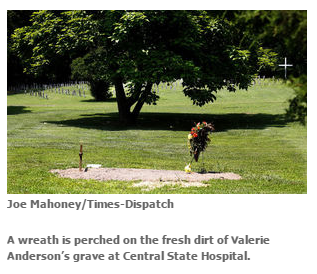
Now to the current unfolding tale of woe, and goodness knows what else that is week by week it seems, unfolding out of Virginia’s Central State Hospital. There have been a series of near damning articles in multiple minor and major newspapers in Virginia detailing the trial of failures it appears that resulted in the death of a woman named Valerie Anderson now buried on the campus of Central State Hospital since she died there.
Grave of Valeria Anderson
The accounts from the various media, best summarized in the article, “State fails to notify family woman dies at Central State Hospital,” which appeared in the July 3, 2016 edition of the Culpepper Star-Exponent, shows that this woman was likely chronically mentally psychotic, a neighborhood recurring disturbing presence and was arrested for misdemeanor trespassing May 14, and was jailed as she was poor and could post a $1,000 bond. She was reportedly evaluated and cleared because of unspecified behavior in jail, and transferred May 24, 2016 to Central State Hospital. All without notifying her family but there were real issues with this part as she was out of follow up treatment and no one seemed to know where her family resided or how to contact them. She then died under unclear circumstances at Central State Hospital May 26th. The family as time went on, found they could not contact her. No one who knew her knew where to look. Meanwhile, the hospital for various and sundry reasons apparently did not do due diligence in following up and trying to establish more information about her and to contact the family. It finally took the Richmond Times-Dispatch in June bringing a Freedom of Information lawsuit to secure, confirm and establish that this lady had died in the hospital. This was prompted as described in the article thusly: “The search for answers in Valerie Anderson’s death was launched in earnest last month after the spokeswoman for the Department of Behavioral health and Developmental Services and other state officials declined to provide any details related to the transfer of an inmate from Hampton Roads Regional Jail to Central State Hospital.”
“Among the information officials initially would not provide about the Central State Hospital death: the patient’s name, gender, and age’ when he or she was transferred to the hospital; when exactly he or she died; and when and why the person had been incarcerated.”
Further, “Later, they to The Times-Dispatch that the patient was female, had been arrested for trespassing; was evaluated and medically cleared on May 24 for admission to a state hospital following mental health crisis at the Portsmouth jail; and was transported Central the following. she was found dead the morning of May 26 by a hospital worker.”
The intrepid reporters for the Times-Dispatch, then armed with the scant information they were able to gain from their Freedom of Information suit, did gumshoe, old-fashioned journalistic ‘detective work.’ and examined Newport News court records, found the record of a Valerie Anderson trespassing charge. And of things in the newspaper “morgue file,” as they used to be called, they found a sticky note marked “Important,” that gave the date of May 25 as her transfer/admission to Central State, and of May 26 as the date of her death.
An instance of denial by hospital officials June 8, to the Times-Dispatch team working the story, prompted them to only dig further [my characterization of what appeared to happen] and her grave was located on the grounds of the hospital. The Times-Dispatch also then were the ones–get this folks!- to locate her family and notify them of her death. Unbelievable…
As it turns out Virginia DOES have good state laws and mandatory procedures for handling patient deaths in state institutions of any kind and they are detailed quite objectively in the above-cited article.There are well-defined time frames in which certain steps must be taken in order and that the steps must go up the state government’s chain of command in a certain order to the highest levels. But the article’s description of the halting effort the hospital made in its description of the events and refusals and declinations to give information makes for sad but also infuriating reading. To make matters worse, the family was rebuffed initially in their efforts to gain information regarding the fate of their mother. This makes for tough reading as the article details the obfuscating and self-justifying responses of the officials that were contacted.
I will end this story with a final slightly lengthy quote which I think emodies the then attitude of the protective state functionaries [a kinder word than I think the families or reporters would use] who were in a position to help the family and reporters: “Anderson had a personal Facebook page and was online frieds with her four children. But social media sites and internet search engines are not part of the process state workers use to locate family members [I would ask WHY NOT?] when someone dies in custody, according to Maria Reppas, spokeswoman for the Virigina Department of Behavioral health and Developmental Serivces…The facility does not take steps such as conducting Google searches or looking through Facebook sites to locate next of kind nor is it required to do so,” Reppas said in a email.
After the family learned through the newspapers’ reporters that their mother was indeed deceased and had been buried in the hospital cemetery, the daughter Jacqueline asked to visit her mother’s gravesite. The article states at its end that she was told she would have to make an appointment to do so.
This writer keeps monitoring for positive developments in the realm of mental health reform and there are more than a few beginning to materialize around the country.
Of brief note is the fact that yesterday, Congress began finally to take positive legislative forward movement on Representative Tim Murphy’s “MHealth Care for Families…” bill to move it toward the Senate and the President’s signature. It is a huge step in the right direction.
Another positive development of note is that New Hampshire, according to a news report by KSL.com, “State hospital opens 10-bed mental health crisis unit,” on its online site for the states’ KSL TV channel, of July 5, 2016, reported that “A new 10-bed mental health crisis unit is open at New Hampshire Hospital after almost a delay of years.” The unit opened in Concord NH but illustrated immediately the enormity of the need in “little ol’ New Hampshire,” as we might say here in the South. On the day after it was opened it already had a waiting list of 23 people for emergency admission.
The article also mentions quite significantly that this entire effort was prompted by the state’s need to comply with a federal lawsuit over these very issues that had been initiated in 2013.
This observer sadly notes that even noble catch-up efforts in the nation’s and states’ mental health reform effort that are need, all good, and well intentioned, often are behind even when they get started but at least we are finally going in the right direction in places now.
But in the neighboring state of Vermont, things are not good. For months there has been well-deserved focus on something one does not hear much about anymore, since President Reagan broke the air controllers’ strike in the 1980’s and the decline of “organized labor” and “unions’ began in this country. Another striking feature of this situation has been that this new labor against management movement has involved healthcare professionals and mental healthcare professionals, which is truly almost totally anState opens new mental health crisis unit unheard of this country. This story has been a gathering storm since last year. It seemed to start in this writer’s mind a few years ago when whichever torrential “Nor’easter” storm savaged its way up the East Coast and into inland New England which is a bit of a rarity. That storm wiped out the state’s only public mental health hospital. Vermont has been limping along borrowing/leasing psychiatric inpatient beds in the state’s small private psychiatric inpatient hospital world. The state has relied most heavily on the Dartmouth Medical School’s inpatient psychiatric services for temporary relief.
This seemed at the time the best solution that could be had on a sort of moment’s notice state of urgency and emergency. But there was trouble in paradise so to speak. Labor problems began within months and built to the point where psychiatric nurses and psychiatrists themselves were fed up with working conditions which I am not privy to at all and began to voice their concerns at the state political level. Apparently, not much was responded to and too little positive corrective action appeared.
So they began to talk of work stoppages, strikes and other things that this writer associated with the United Mine Workers’ and United Steelworkers’ and Teamsters’ unions of the 1960’s and 1970’s that were every few years regular events. It was like Yogi Berra summarized in his most famous quote, “Deja vue all over again.” I personally know of psychiatrists through indirect sources that the psychiatrists were not just posturing to wangle higher wages, but were so serious that they were actively looking for jobs elsewhere, so strongly did the group of them feel about the deficiencies of patient care and availability. And Dartmouth and the State were caught in the middle I suppose, trying to generous and even-handed about all this.
This is yet another symptom of how bitter and unfortunately rancorous the processs of advocating for change can be anywhere, in any system, when the vehicle being ‘recalled and repaired and retooled’ can be at present when we attempt both short term and long term fixes that neither come easily nor rapidly enough. Again this writer will follow this story closely. I for one have never been on strike, though I went through them as a child decades ago as both my parents worked in the mining industry and this a regular every so many years event. And in the spirit of transparency, I know I could not do this and abandon my own patients.
A troubling development repeated itself at the famed Bridgewater State Hospital in Massachusetts, the place where the “Boston Strangler,” Albert DeSalvo, and the model for the cult classic movie of the 1860’s, “TheTiticut Follies,” occurred in late June. Another patient death by suicide within the facility.
In an article entitled “Suicide spurs call for receivership at state hospital,” written by Katie Lannan of the STATE HOUSE NEWS SERVICE of the Newbury Port Daily News detailed the now repetitive tragedy. The Center had tardily reported on April 8, 2016 the death of Mr. Leo Marinio from Lawrence MA who killed himself by “ingesting large quantities of toilet paper while in isolation.” The local state advocacy organization, The Disability Law Center of Boston was calling for the entire facility to be placed into “receivership” and for the state to move on plans to transfer the control and operation of the hospital from the Department of Corrections to the Department of Mental Health.
Two aspects of this case are troublesome to this reader. First, the report of the death appears from this and media reports to have been delayed by weeks, and deceased had somehow in isolation been able to stuff enough foreign material into his throat to block his own airway and have time to die possibly unobserved.
Where I practice in the state of North Carolina, a death within any state institution whether it be a mental health, nursing home, hospital, or correctional facility, MUST be reported to the state authorities within a time limit of 24 hours. How this may have been delayed this long is astounding to this writer. Any unnatural or unexplained death even in any kind of hospital must so be reported within such a time frame to permit timely review and objective investigation of the cause of death and its circumstances, in a constant effort at self-correction of procedures and public airing of findings. We see the same kind of hush-hush delays nowadays in correctional, meaning police related deaths going on and receiving national news coverage when people die in police custody, being taken into police custody and it seems nowadays to take a judicial order to release timely records involved in such untimely deaths, such as on the spot videos that are so common now.
Second, this facility which has dealt with the forensically seriously mentally ill for generations, was run by the Department of Corrections, not an agency tasked with dealing with complexities of the mentally ill, though it must be stated that it is still possible and does happen also in mental health run forensic facilities that suicides occur. But it was a real surprise to this writer than Bridgewater State was not in my mind a “hospital,” as I had always thought, but a correctional facility with all that that circumstance can bring with it, such as overuse of isolation for corrective measures, and a lack of training in dealing with the seriously mentally ill.
The article sadly, in my mind reports that it had recommended such a move nearly two years ago the then Governor Duvall in 2014 because of similar issues detailed in this blog in which three deaths were involved.
This writer will watch this situation and monitor how the state machinery and political system handles this in the future and “report back” to the reader.
After several years, much needed mental health reform legislation at the Federal level may finally be coming our way.
I must state at the outset, the gnawing sentiment that at least some of the suddenly growing and politically fashionable reason for pols to jump on this now aged, creaky bandwagon stems from the recent years of increasingly frequent mass shooting we have experienced in this country. And the growing heart-rending and hard to shout down with caustic political rhetoric often based on hysterical fears of somehow losing “our” guns rabid pushback that seems to instantly spring from the same blusterers of certain quarters because, surprise, surprise, these atrocities are committed with guns instead of Nerf toys.

 The Mental Health Reform Blog